Guide · 5-minute read
Are research peptides legal? And how to vet a supplier.
Updated October 4, 2026. Written by PUŪRA, a U.S. research-peptide supplier. These checks apply to us too.
The short answer
Most research peptides are not federally controlled substances, and suppliers sell them for laboratory research. No compound sold for research use is approved for use in people.
The FDA judges a product by all the evidence of its intended use, not by its label alone. Some states regulate certain compounds more tightly, and growth hormone carries separate federal penalties.
What “research use only” means
“For research use only” marks a compound sold for laboratory study, not as a medicine. The label is only part of the picture. Under federal rules, the U.S. Food and Drug Administration looks at everything around a product: the website, the marketing and the advice that comes with it.
In 2026 the FDA sent warning letters to online peptide sellers whose websites, it said, showed their products were meant for use in people, despite “research only” labels.
What the 2026 FDA committee vote changed
On July 23 and 24, 2026, an FDA advisory committee voted on seven peptides for the list that pharmacies may compound from, with a prescription. Six were recommended, each by two or three votes; a seventh failed by one. It was widely reported as an approval. It was not.
- The committee advises; the FDA decides. Its votes are recommendations, not rulings.
- Nothing has changed in law yet. The FDA would first have to propose and finalize a rule, which could take until 2027 or longer. Another committee meeting on further peptides is expected before the end of February 2027.
- Even then, it covers pharmacies. The change would let licensed compounding pharmacies prepare these peptides on a prescription. It would not make them approved drugs or over-the-counter products.
Six checks before ordering from any supplier
The research market is young, and scammers know it. When a well-known supplier closed in March 2026, copycat sites using its name followed, took payment and shipped nothing. These six checks take a few minutes.
- 01
Pay by credit card
Under the Fair Credit Billing Act, you can dispute a credit card charge for goods not delivered as agreed, in writing, within 60 days of the first statement that shows it. Debit cards carry weaker protection. The FTC warns that scammers ask for payment that is hard to trace or reverse, such as Zelle, Cash App, wire transfers and crypto.
- 02
Find a real business behind the site
A registered company name, a U.S. business address and a support email that gets answered. Sellers who work only through Telegram, Discord or direct messages are hard to hold to anything.
- 03
Check the address bar twice
Copycat sites borrow a known brand’s name with one letter changed, an extra word or a different ending. Type the address yourself or use a bookmark, rather than following a link from a message.
- 04
Read the certificates before you order
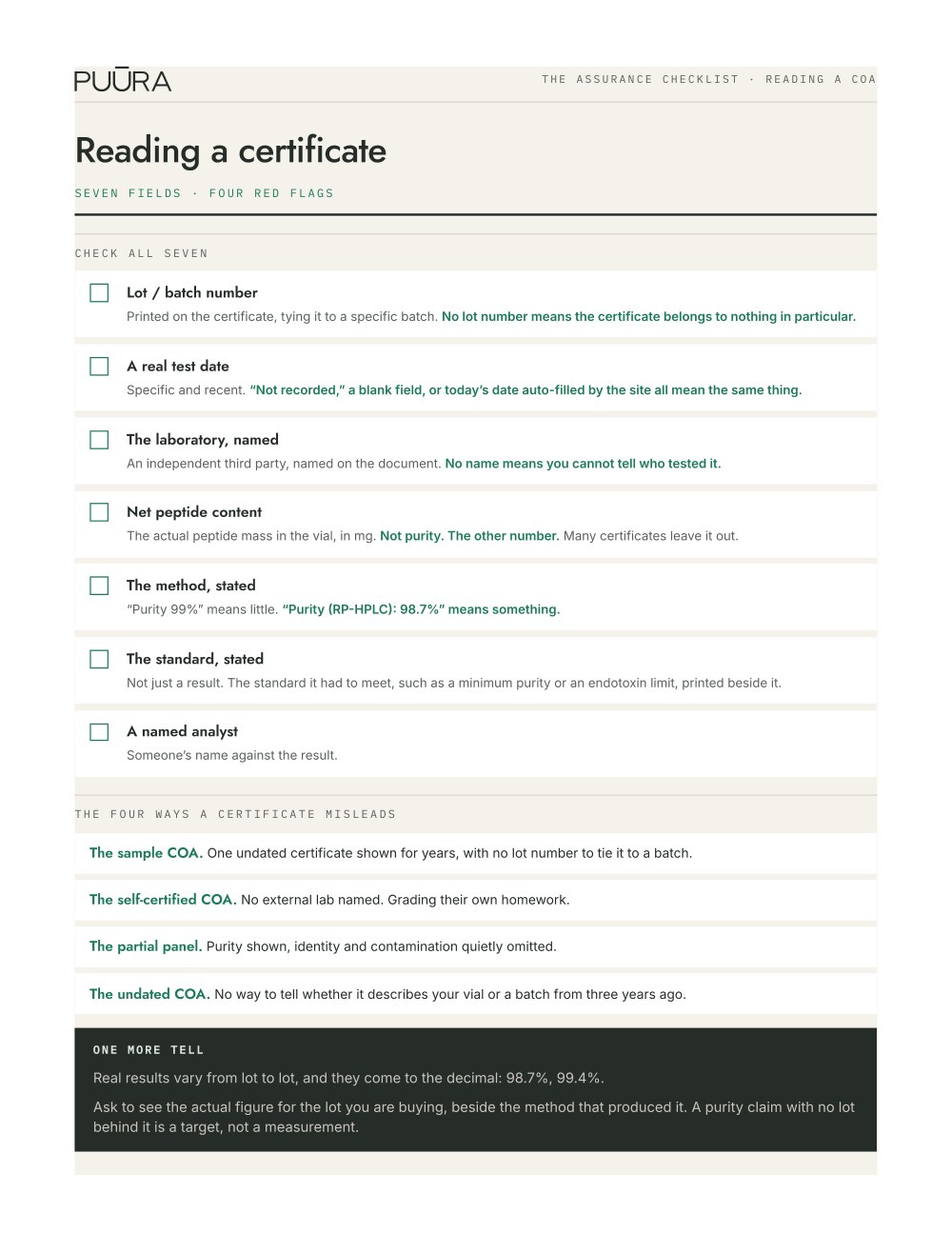
Look for certificates from an independent U.S. laboratory, published where anyone can read them, each showing the laboratory and the report date. Our free checklist shows the seven fields to look for.
- 05
Distrust the deep discount
Testing and careful handling cost the same for everyone. A price far below the market has to come from somewhere.
- 06
Walk away from therapeutic promises
A research supplier that promises therapeutic results, posts dosing charts or shows before-and-after photos is selling outside the rules. Walk away.
Get the checklist. Seven fields to check on any certificate, free by email. Send it to me.
Sources
- How the FDA judges intended use (21 CFR 201.128)
- An FDA warning letter to an online peptide seller, August 24, 2026
- McDermott Will & Schulte on the July 2026 committee votes
- FDA Pharmacy Compounding Advisory Committee meetings
- DEA list of controlled substances
- New York Public Health Law §3306 (controlled substance schedules)
- Federal penalties for distributing growth hormone (21 U.S.C. 333(e))
- Project Biohacking on a supplier's March 2026 closure
- Customer reviews of a copycat site, Trustpilot
- FTC: disputing credit card charges
- FTC: what to do if you were scammed