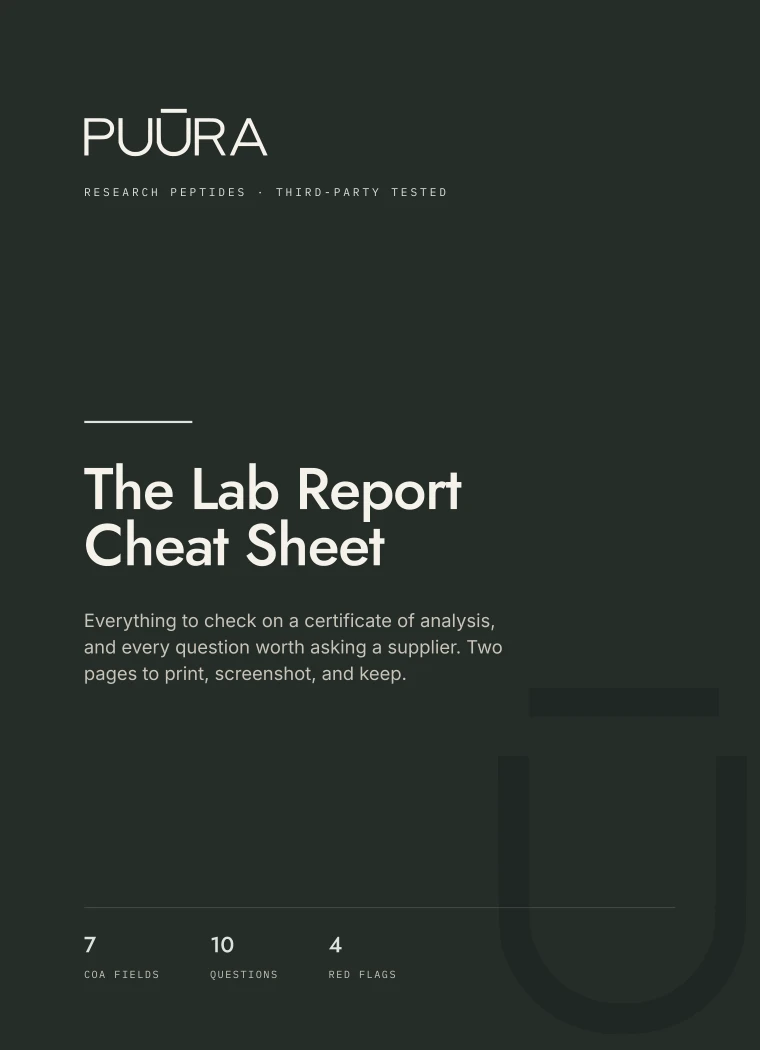
The cheat sheet · 4 pages
The Lab Report Cheat Sheet
- The seven fields every trustworthy certificate shows.
- How to tell a lot-specific certificate from a generic one, in under a minute.
- Ten questions to ask any supplier. We welcome all ten.
How to properly read a lab report in under 30 seconds.
From PUŪRA, a U.S. research peptide supplier built on independent laboratory testing.
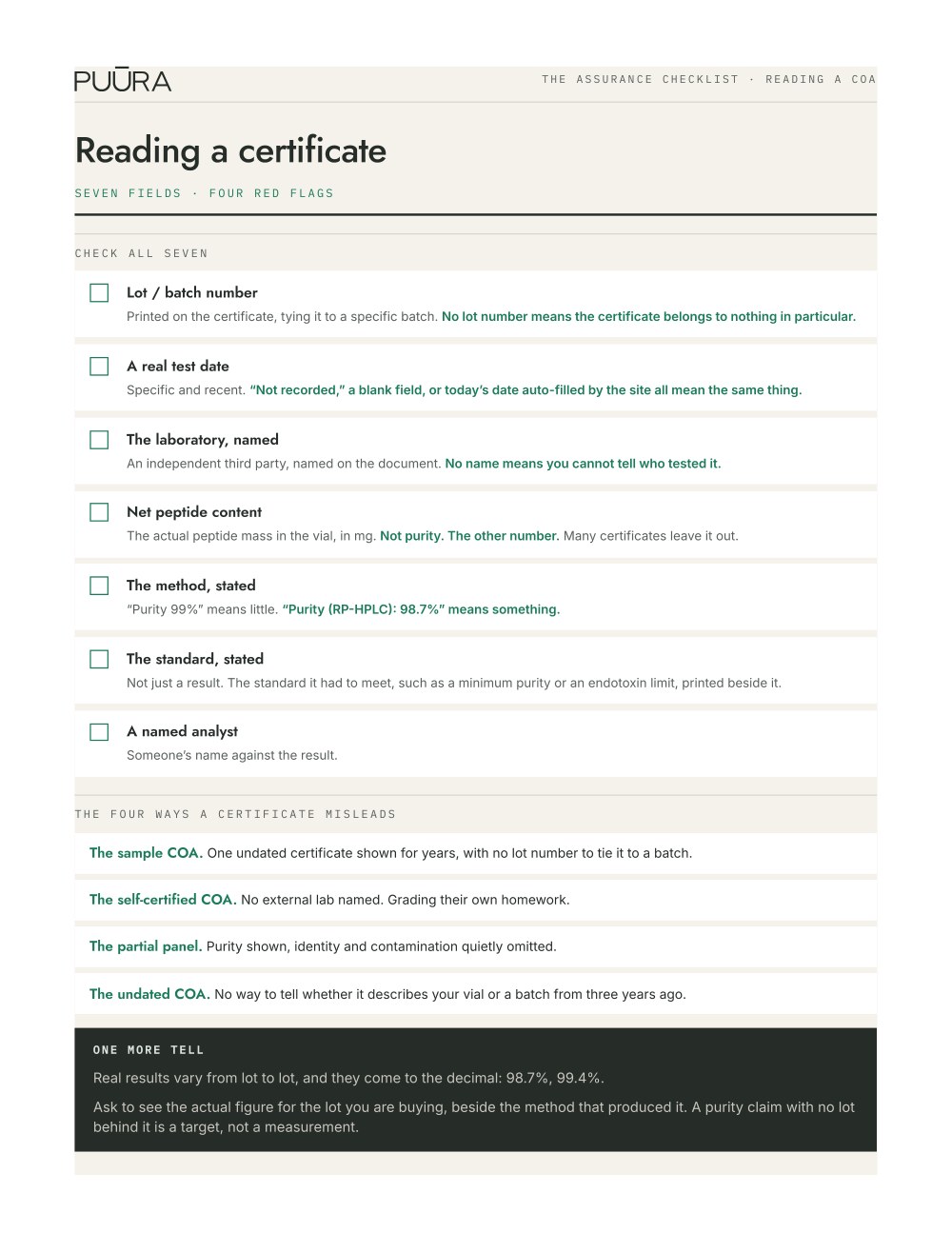
The real page two of four
Seven fields to tick off, and four ways a report can look fine and tell you nothing. If three of the seven are missing, ask the supplier why.
Sign up once and you get the cheat sheet and both guides. Plain English, and every claim shows the kind of study behind it.
The cheat sheet · 4 pages
Guide one · 9 pages
Guide two · 10 pages
Evidence, clearly labelled
Every finding is shown with the kind of study behind it, so you know how much weight it carries.
The full picture
What the research shows, and where it is still developing, side by side.
Education, not instructions
Science you can trust, written for research use only.
From Peptides 101, chapter four
LABEL SAYS
VIAL ACTUALLY CONTAINS
Net peptide content for research material commonly lands between 70% and 90%.
A sample, before you give us anything
Lyophilized powder also holds counterion salts left over from purification, plus residual water. So a vial can be 99% pure and 79% peptide by mass at the same time. Both numbers are true. They answer different questions, and only one usually appears on a product page. The kit has about forty more ideas like this one.
Next question: Are research peptides legal? And how to vet a supplier · A real lab report, read line by line
Authenticity and transparency aren’t a tagline. They’re our business model.
We’d rather hand you the tools to judge any supplier, us included, than ask you to take our word for it.
Disclaimer: All content is for research and educational purposes only. It is not medical advice and is not a substitute for consultation with a qualified healthcare professional. Nothing in these materials should be interpreted as a recommendation to use any compound in humans or animals. All products referenced are sold strictly for laboratory research use only, are not for human or veterinary consumption, and are not intended to diagnose, treat, cure, or prevent any disease.